
สารพีอีไอทีซีจากผักตระกูลกะหล่ำในปริมาณที่คนรับประทานได้ ยับยั้งการเจริญเติบโตของเซลล์มะเร็งช่องปากที่มียีน p53 กลายพันธุ์ ทั้งในห้องปฏิบัติการ และในสัตว์ทดลอง
สถาบันโภชนาการ มหาวิทยาลัยมหิดล


{:th}
สารพีอีไอทีซีจากผักตระกูลกะหล่ำในปริมาณที่คนรับประทานได้ ยับยั้งการเจริญเติบโตของเซลล์มะเร็งช่องปากที่มียีน p53 กลายพันธุ์ ทั้งในห้องปฏิบัติการ และในสัตว์ทดลอง
สถาบันโภชนาการ มหาวิทยาลัยมหิดล
ผลงานวิจัย :
สารพีอีไอทีซีจากผักตระกูลกะหล่ำในปริมาณที่คนรับประทานได้ ยับยั้งการเจริญเติบโตของเซลล์มะเร็งช่องปากที่มียีน p53 กลายพันธุ์ ทั้งในห้องปฏิบัติการ และในสัตว์ทดลอง
ผู้วิจัย :
อรุณวรรณ หลำอุบล, อะลิสัน ลี ฟิซเจอรอล, อาณัติ ฤทธิ์เดช, ถาวรีย์ พลเยี่ยม, ฮุ้ย จาง, เจฟฟรี เอ็น ไมเยอร์, เผิง หวง และ ดุลยพร ตราชูธรรม
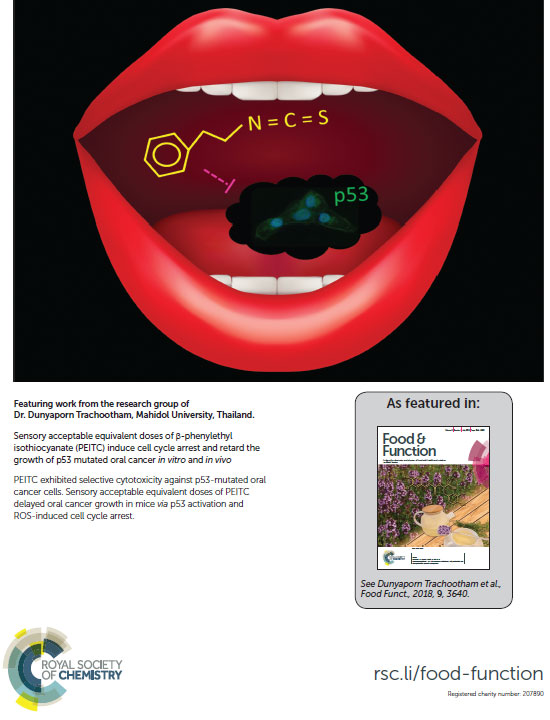
สารจากอาหารหลายชนิดมีฤทธิ์ต้านมะเร็งเมื่อให้ในความเข้มข้นสูง เช่น สารพีอีไอทีซี ซึ่งเป็นพฤกษเคมี จากผักตระกูลกะหล่ำ อย่างไรก็ตามความเข้มข้นสูงนั้น ไม่เหมาะกับการบริโภค เพราะจะระคายเคืองช่องปาก งานวิจัยนี้จึงมุ่งศึกษาฤทธิ์ขอสารพีอีไอทีซีในระดับความเข้มข้นเทียบเท่ากับระดับที่คนรับประทานได้ ผลการศึกษาในห้องปฏิบัติการพบว่า สารพีอีไอทีซีเป็นพิษต่อเซลล์มะเร็งอย่างจำเพาะ โดยไม่ก่อพิษต่อเซลล์ปกติ ผลการศึกษาในหนูทดลองพบว่า สารพีอีไอทีซีในระดับความเข้มข้นเทียบเท่ากับที่คนรับประทานได้ ช่วยให้ก้อนมะเร็งโตช้าลง และช่วยยืดอายุของหนูที่เป็นมะเร็งช่องปากชนิดที่มียีน p53 กลายพันธุ์ ให้มีชีวิตรอดนานขึ้น ในแง่กลไก สารพีอีไอทีซีทำให้เกิดความเครียดอนุมูลอิสระ กระตุ้นการทำงานของโปรตีน p53 และ p21 และทำให้เซลล์มะเร็งหยุดแบ่งตัว งานวิจัยนี้ได้ผลสรุปว่า สารพีอีไอทีซีที่ระดับความเข้มข้นเทียบเท่ากับที่คนรับประทานได้นั้น สามารถยับยั้งการเติบโตของเซลล์มะเร็งอย่างจำเพาะผ่านกลไกอนุมูลอิสระ จนทำให้โรคมะเร็งลุกลามช้าลง และทำให้มีชีวิตอยู่รอดนานขึ้น ดังนั้น สารพีอีไอทีซีจึงน่าจะเป็นสารออกฤทธิ์ที่ใช้ในการป้องกันมะเร็งช่องปากได้
การนำไปใช้ประโยชน์ : การนำองค์ความรู้ไปพัฒนาต่อยอด เป็นผลิตภัณฑ์อาหารสำหรับผู้ป่วยมะเร็งช่องปาก ในการคงสภาพร่างกายไม่ให้ทรุดไปกว่าเดิม และส่งเสริมคุณภาพชีวิต ขณะนี้กำลังมีการวิจัยต่อในคลินิก
การเผยแพร่ผลงาน : ตีพิมพ์ในวารสาร และขึ้นปกหลังวารสารฟูดส์แอนด์ฟังก์ชั่น ฉบับที่ 9 ปี พ.ศ. 2561 หน้า 3640 – 3656
การติดต่อ :
ผศ.ดร.ทพญ.ดุลยพร ตราชูธรรม
สถาบันโภชนาการ มหาวิทยาลัยมหิดล
dunyaporn.tra@mahidol.ac.th, dunyaporn.tra@,mahidol.edu
Sensory acceptable equivalent doses of β -phenylethyl isothiocyanate (PEITC) induce cell cycle arrest and retard the growth of p53 mutated oral cancer in vitro and in vivo
Institute of Nutrition, Mahidol University
Title :
Sensory acceptable equivalent doses of β -phenylethyl isothiocyanate (PEITC) induce cell cycle arrest and retard the growth of p53 mutated oral cancer in vitro and in vivo
Researchers :
Aroonwan Lam-ubol, Alison Lea Fitzgerald, Arnat Ritdej, Tawaree Phonyiam, Hui Zhang, Jeffrey N. Myers, Peng Huang and Dunyaporn Trachootham
Many bioactive food compounds such as β-phenylethyl isothiocyanate (PEITC), a phytochemical in cruciferous vegetables, showed anti-cancer effects at high dose. However, such high dose is not feasible for consumption due to a strong mouth-tingling effect. This study investigated the anti-cancer effect of PEITC at sensory acceptable doses. In vitro, PEITC was selectively toxic to several kinds of oral cancer cells compared to non-tumor oral cells. In vivo, PEITC at the doses equivalent to human sensory acceptable doses, retarded tumor growth and prolonged the survival of mice bearing p53-mutated oral cancer cells. Mechanistically, PEITC induced oxidative stress, activation of protein p53 and p21 and stopped division of cancer cells. These findings suggested that the sensory acceptable doses of PEITC selectively inhibit cancer cell growth through oxidative stress -mediated mechanism leading to delayed tumor progression and extended survival. PEITC could be a functional ingredient for oral cancer prevention.
Applied Research Project to Usage : The research findings from this work have been used for research and development of novel food products for oral cancer patients to maintain their health in stable condition and promote quality of life.
Publishing : Featured on the back cover of Food & Function, an international peer-review journal Food Funct., 2018, 9, 3640 – 3656.
Key Contact Person :
Asst.Prof.Dr.Dunyaporn Trachootham
Institute of Nutrition, Mahidol University
dunyaporn.tra@mahidol.ac.th, dunyaporn.tra@,mahidol.edu