
ประเทศไทยปลอดไขมันทรานส์
สถาบันโภชนาการ มหาวิทยาลัยมหิดล


{:th}
ประเทศไทยปลอดไขมันทรานส์
สถาบันโภชนาการ มหาวิทยาลัยมหิดล
ผลงานวิจัย :
ประเทศไทยปลอดไขมันทรานส์
ผู้วิจัย :
ศ.ดร.วิสิฐ จะวะสิต
การปนเปื้อนของกรดไขมันชนิดทรานส์ในอาหาร มีผลกระทบทางลบต่อสุขภาพของผู้บริโภค จึงเป็นข้อกังวลสำหรับหน่วยงานด้านนโยบายสาธารณสุข และมีผลต่อการส่งออกผลิตภัณฑ์อาหาร ไปยังประเทศที่ห้ามนำเข้าผลิตภัณฑ์อาหารที่ปนเปื้อนด้วยกรดไขมันชนิดทรานส์ งานวิจัยนี้มีวัตถุประสงค์ให้ประเทศไทยปลอดการปนเปื้อนกรดไขมันชนิดทรานส์ในอาหาร ในระดับที่ก่อให้เกิดอันตรายต่อสุขภาพ โดยมุ่งเน้นที่น้ำมันและไขมันซึ่งผ่านกระบวนการเติมไฮโดรเจนบางส่วนในระดับอุตสาหกรรม (Industrial Partial Hydrogenation) รวมถึงส่วนประกอบ และผลิตภัณฑ์อาหารที่มีการใช้น้ำมันหรือไขมันที่ผ่านกระบวนการเติมไฮโดรเจนบางส่วนในการเตรียมหรือเป็นส่วนผสม ทั้งนี้ ไม่รวมถึงการปนเปื้อนจากกรดไขมันทรานส์ที่มีตามธรรมชาติ
จากการประเมินสถานการณ์การปนเปื้อนกรดไขมันชนิดทรานส์ ในอาหารที่มีจำหน่ายในประเทศไทย พบว่าอาหารในท้องตลาดที่ปนเปื้อนกรดไขมันชนิดทรานส์ในระดับเกินกว่าที่องค์การอนามัยโลกกำหนด (> 2.2 กรัมต่อวัน หรือ > 0.5 กรัมต่อมื้อ) ได้แก่ โดนัททอด พัฟและเพสทรี เวเฟอร์ มาร์การีน และเนย เพียงบางยี่ห้อเท่านั้น นอกจากนี้ ยังพบว่ากรดไขมันอิ่มตัว (> 5 กรัมต่อมื้อ) เป็นปัญหาทางโภชนาการที่สำคัญกว่ากรดไขมันชนิดทรานส์ในกลุ่มผลิตภัณฑ์อาหารที่ศึกษา
ผลการวิจัยได้ข้อสรุปว่า ประเทศไทยสามารถประกาศสถานะปลอดการปนเปื้อนกรดไขมันชนิดทรานส์ได้ภายใน 1 ปี เพื่อไม่ให้มีผลเชิงลบต่อสุขภาพของผู้บริโภคอย่างต่อเนื่อง และควรดำเนินการภายใต้เงื่อนไขดังต่อไปนี้ (1) คำจำกัดความของ “ปลอดไขมันทรานส์” มิใช่การตรวจไม่พบกรดไขมันชนิดทรานส์ แต่เป็นการกำหนดความเข้มข้นสูงสุดที่ยอมให้มีได้ โดยใช้ปริมาณที่ไม่ก่อความเสี่ยงเชิงสุขภาพเป็นเกณฑ์ ได้แก่ < 0.5 กรัมต่อหน่วยบริโภค (2) ผู้ผลิตน้ำมันและไขมันดำเนินการพัฒนาผลิตภัณฑ์ทดแทนผลิตภัณฑ์เดิมที่ปนเปื้อนกรดไขมันชนิดทรานส์ โดยใช้กระบวนการผสมน้ำมัน (Oil Blending) ซึ่งต้นทุนด้านเทคโนโลยีและวัตถุดิบไม่สูง (3) เร่งรัดมาตรการด้านกฏหมายที่ห้ามมิให้ใช้ไขมันที่ผลิตจากกระบวนการเติมไฮโดรเจนบางส่วนในการผลิตอาหาร เพื่อลดการได้เปรียบและเสียเปรียบทางการค้าของผู้ผลิตอาหาร และเฝ้าระวังการทุ่มตลาดของสินค้าคัดทิ้งจากประเทศสหรัฐอเมริกา และ (4) การกล่าวอ้างทางโภชนาการในผลิตภัณฑ์อาหารที่เกี่ยวกับปริมาณไขมันทรานส์ ซึ่งต้องพิจารณาทั้งปริมาณกรดไขมันชนิดทรานส์และกรดไขมันอิ่มตัว เพื่อไม่ให้ผู้บริโภคสับสนและเกิดผลเสียต่อสุขภาพ
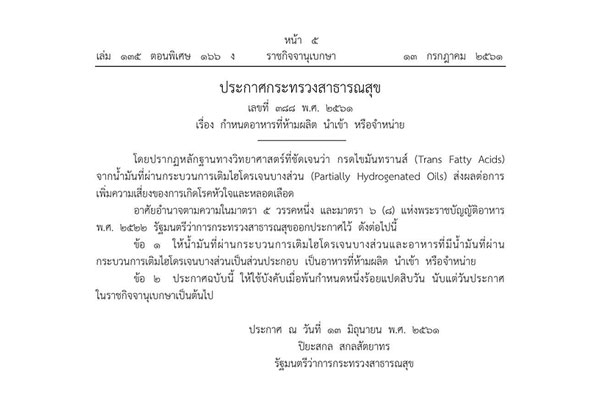
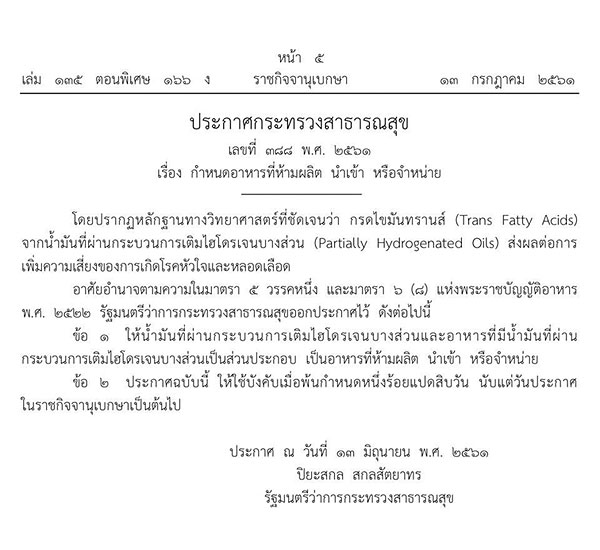
การนำไปใช้ประโยชน์ : ปรับประกาศกระทรวงสาธารณสุข เลขที่ ๓๘๘ พ.ศ. ๒๕๖๑ เรื่องกำหนดอาหารที่ห้ามผลิต นำเข้า หรือจำหน่าย เพื่อวางนโยบายการบริหารจัดการและการควบคุมปัญหาการปนเปื้อนของกรดไขมันชนิดทรานส์ ในผลิตภัณฑ์อาหารที่ผลิตเพื่อการบริโภคในประเทศและส่งออก รวมถึงผลิตภัณฑ์อาหารนำเข้า ซึ่งจะเป็นการรองรับการเป็นประเทศปลอดไขมันทรานส์ (Trans Fat – Free Country) ในอนาคต
แหล่งทุน : สำนักงานพัฒนาการวิจัยการเกษตร (องค์การมหาชน)
การติดต่อ :
ศ.ดร.วิสิฐ จะวะสิต
สถาบันโภชนาการ มหาวิทยาลัยมหิดล
visith.cha@mahidol.ac.th
{:}{:en}
Thailand: Trans Fat – Free Country
Institute of Nutrition, Mahidol University
Title :
Thailand: Trans Fat – Free Country
Researcher :
Prof.Dr.Visith Chavasit
Since trans fat can cause negative impact to consumer’s health, it is therefore the concern of health policy organizations. Besides, it can affect the food exportation to the countries that ban trans fat. The objective of this research was to evaluate the feasibility in freeing Thailand from foods that contaminated with trans fat at the health-harmful level by controlling at industrial partial hydrogenated fats and oils as well as their consequent products i.e. food ingredients and products however not including trans fat from nature.
Our research indicated that commercial food products of certain brands in Thailand i.e. deep – fried donuts, puff, pastries, wafer, margarine and butter were contaminated with trans fat at the health harmful level regarding the World Health Organization’s recommendation (> 2.2 g/day or > 0.5 g/serving). Furthermore, the saturated fats found in all brands of the mentioned food products were also at the harmful levels (> 5 g/serving). It had been concluded that Thailand could be free from trans fat within 1 year. To avoid the negative side effects to the consumer’s health, the strategy must be performed under the following conditions i.e. (1) definition of “trans fat free” must not be at zero tolerance but at tolerable level that doesn’t cause health risk (< 0.5 g/serving), (2) Oil blending should be the most economical technology at this moment used for replacing partial hydrogenation process, (3) prohibition on the use of partially hydrogenated fat in foods must urgently be enforced in order to reduce the unfair trade advantage of the trans fat contaminated food products that are locally produced and dumped from the U.S. market, and (4) criteria for nutrient claim on trans fat must include saturated fat in order to prevent consumer’s confusion that consequently causes health harm.
Applied Research Project to Usage : Use as the information for issuing Ministry of Public Health’s notification on banning the use of partially hydrogenated oils in foods in Thailand and for exportation.
Funding Agency : The Agricultural Research Development Agency (Public Organization)
Key Contact Person :
Prof.Dr.Visith Chavasit
Institute of Nutrition, Mahidol University
visith.cha@mahidol.ac.th